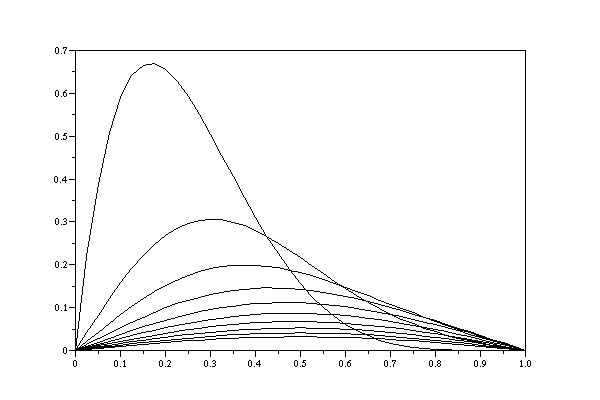
There are 6 functions below:
function a=u0(x)
a=10*x.*(1-x).^5;
endfunction
function x=tridiag(d,u,l,r)
//  solve  [   d1  u1  0   0          ] [ x1 ]  =  [ r1 ]
//         [   l1  d2  u2  0          ] [ x2 ]     [ r2 ]
//         [   0   l2  d3  u3         ] [ x3 ]     [ r3 ]
//         [   0   0   l3  d4  ....   ] [ x4 ]     [ r4 ]
//         [        :                 ] [  : ]     [  : ]
ds=size(d,1)
us=size(u,1)
ls=size(l,1)
rs=size(r,1)
x=zeros(ds,1)
if (us==ds-1 & ls==ds-1 & rs==ds )
   for i=2:ds
    fact=l(i-1)/d(i-1)
    l(i-1)=0;
    d(i)=d(i)-fact*u(i-1)
    r(i)=r(i)-fact*r(i-1)
   end
   x(ds)=r(ds)/d(ds)
   for i=ds-1:-1:1
    x(i)=(r(i)-u(i)*x(i+1))/d(i)
   end
else
   x=0            // this will give an error if input sizes don't match
end
endfunction
function a=step(u,nu)
d=size(u,2);
a=zeros(1,d);
a(1)=0;
a(d)=0;
for i=2:d-1
  a(i)=u(i)+nu*(u(i-1)-2*u(i)+u(i+1));
end
endfunction
function s=parint(T,J,N)
x=(1/J)*[0:J]
u=u0(x)
t=0
s=0
nu=T*J*J/N
xbasc(0)
plot2d(x,u)
for i=1:N
  u=step(u,nu);
  t=t+nu/(J*J);
  if (t-s>0.025)
    plot2d(x,u)
    s=t
  end
end
endfunction
function unew=step2(u,nu,theta)
dimu=size(u,1);
D=zeros(dimu,1)
U=zeros(dimu-1,1)
L=zeros(dimu-1,1)
R=zeros(dimu,1)
D=D+(1+2*theta*nu)
D(1)=1
D(dimu)=1
U=U-theta*nu
U(1)=0
L=L-theta*nu
L(dimu-1)=0
m1=1-2*(1-theta)*nu
m2=(1-theta)*nu
R(1)=0
R(dimu)=0
for i=2:dimu-1
  R(i)=m1*u(i)+m2*(u(i-1)+u(i+1))
end
unew=tridiag(D,U,L,R)
endfunction
function s=parint2(T,J,N,theta)
                  //  T=total time, J=steps in x-dirn, N=steps in t-dirn, theta
x=(1/J)*[0:J]'
u=u0(x)
t=0
s=0
nu=T*J*J/N
xbasc(0)
plot2d(x,u)
for i=1:N
  u=step2(u,nu,theta);
  t=t+T/N;
  if (t-s>0.025)
    plot2d(x,u)
    s=t
  end
end
endfunction
To see that the theta method does not require such large numbers of steps in the t direction, provided theta is at least 1/2, run parint2(1,40,80,0.4) (fails) and parint2(1,40,80,0.5), parint2(1,40,80,0.6) (both work fine). Note the vast improvement of speed over the explicit method!