My research develops topological and computational methods for characterizing the structure of large cellular and atomistic systems, and for understanding how such structures form and evolve over time. This work draws on discrete geometry, applied topology, and statistics, and is motivated by concrete problems in materials science and in the physics of ordered, disordered, and active matter.
A complete list of papers is on my publications page; see also my Google Scholar profile.
Topological Methods for Structure Analysis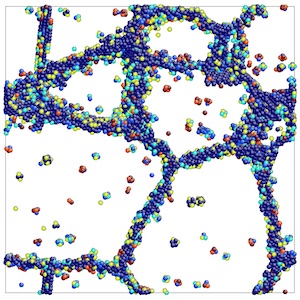
A common challenge in studying physical systems is describing the "structure" of a set of points in space. Continuous, real-valued order parameters are widely used for this purpose, but they also have certain limitations. Topological methods provide an alternative that avoids some of these limitations and yields robust, structure-independent tools for practical computation. One particular strength is the ability to identify defects in crystals at high temperatures — up to roughly 95% of the melting point, where conventional methods often struggle above 50%.
More recent work extends this framework from simple crystals to general crystalline systems, and develops methods for the automated enumeration of the Voronoi cell topologies that characterize complex crystal structures. These ideas are implemented in VoroTop, an open-source toolkit for structure analysis in two and three dimensions.
Structure in Disordered and Active Matter
Voronoi topology provides discrete, parameter-free descriptors of local structure that are useful well beyond perfect crystals — for liquids, glasses, hyperuniform systems, and active matter. In collaboration with Gil Ariel and Avraham Be'er, we have introduced a pair correlation function based on Voronoi topology and, more recently, a Voronoi–graph spectrum for distinguishing disordered phases. Related work characterizes two-dimensional particle systems through their Voronoi topology.
Grain Growth and Evolving Cellular Structures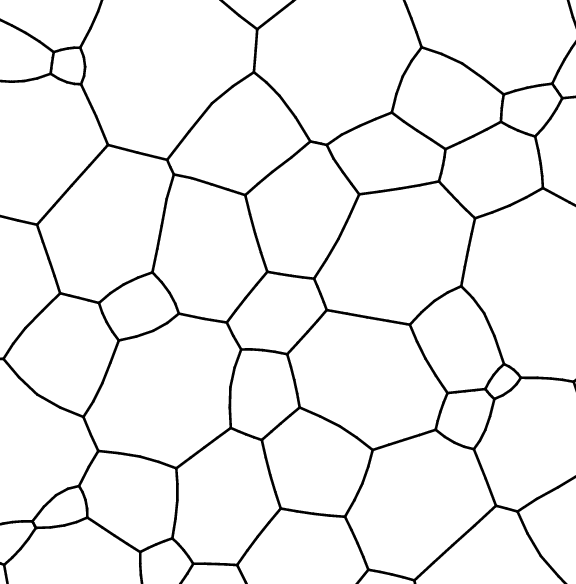
Many cellular structures in nature — biological tissue, soap foams, polycrystalline metals, even international borders — evolve over time in complicated ways, and understanding this evolution is central to understanding their large-scale properties. We study both the short- and long-term dynamics of these structures, and the distribution of topological types that emerges in grain-growth microstructures. Click here to learn more.
Polyhedral Cells in Natural Structures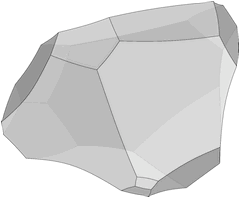
I am interested in understanding the (roughly) convex polyhedra found in disordered cellular structures. Among other properties, we consider the frequency with which particular topological types appear in various structures. Click here to learn more.
Three-Dimensional Poisson-Voronoi TessellationsVoronoi tessellations of Poisson point processes are widely used for modeling physical and biological systems. Here we analyze simulated Poisson-Voronoi structures containing a total of 250,000,000 cells to provide topological and geometrical statistics of this important class of networks.
Schlegel Diagrams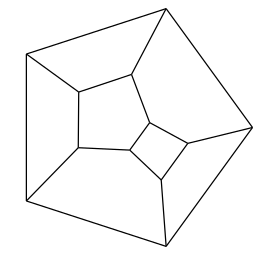
A Schlegel diagram is the projection of a polytope from d-dimensional space into d−1 dimensions, and can be useful for studying three-dimensional polyhedra. Click here for a brief explanation.
Earlier Work: Mechanical Properties of Metal FractureAs an undergraduate and in the summers that followed, I used molecular-dynamics simulations to study how polycrystalline metals crystallize and fracture — developing algorithms to identify grains and grain boundaries, and examining how grain size and orientation influence properties such as strength and elasticity. This work was guided by Shlomo Ta'asan; a copy of my thesis is available here.
FundingThis research has been supported by the Israel Science Foundation (grant 202/24) and the U.S.–Israel Binational Science Foundation (grant 2018/170). Earlier work was supported by the U.S. National Science Foundation (grant DMR-1507013).